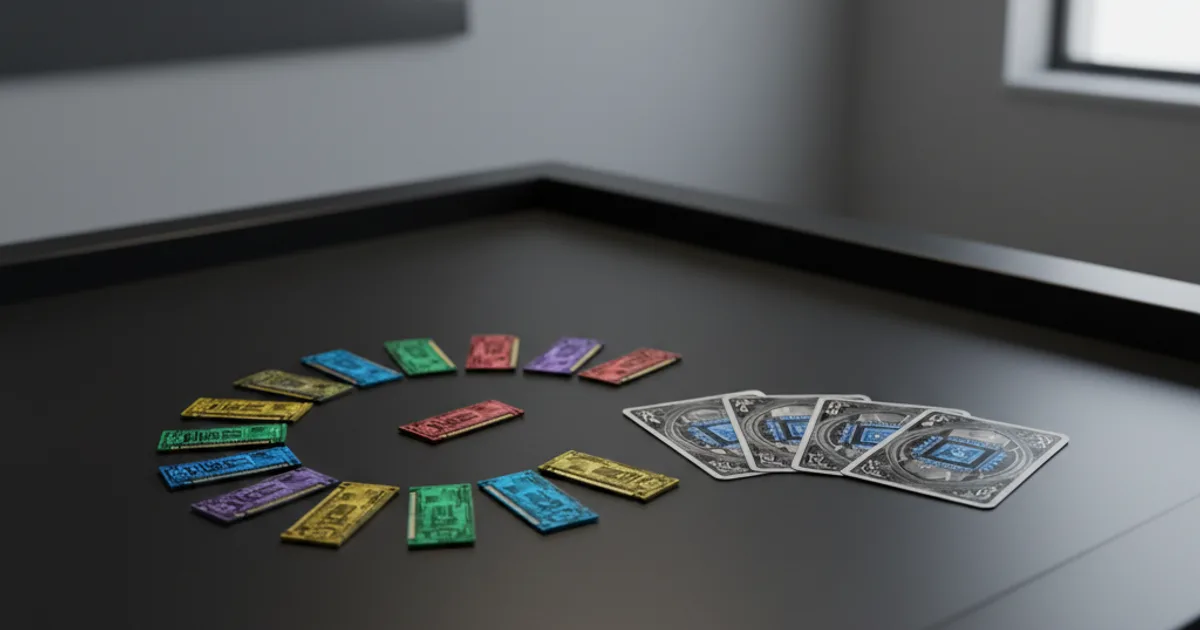
Start with the joke, because it tells you what kind of set this is.
The last card in Genesis is Terry, the Accountant (GEN-256), a 0/3 Corpo accountant on a beach with a piña colada, immune to psychosis, holding an ability called SWIPE PLATINUM whose instruction is to swipe him across the arena like a credit card to attach a piece of gear. In the bottom-left corner, where every card prints its place in the set, Terry prints 256/255.
A 255-card set with a 256th card in it. That is either a lovely gag or a numbering accident nobody wanted to fix, and having now read the whole thing, we lean towards the gag.
What follows is a read of all 255 cards in Genesis, which is currently the whole of Neuroscape. No second set is announced in anything we hold, so there is no rotation and no format to fall out of. Everything printed is legal, which makes a set review unusually easy to write and unusually hard to hedge: there is nowhere else for a card to go.
What this is built on, and what it is not
Every card fact here comes from our own Genesis catalogue, which holds all 255 cards, and every rules claim from our rules page, which is our reading of the publisher's Neuroscape Rulebook V10.2, updated 16 June 2026. Where the two disagree, the rulebook wins and we have said so on the page.
Two honest limits, up front.
Nobody has published a result. Nothing we hold carries a standing, a field share or a placing. Our own community decks page is empty, because nobody has built one yet. So this piece argues from card text and from the rules, and never from results, because results do not exist. When we say a card is strong, we mean the rules make it strong, not that it has beaten anybody.
Our own card pages do not carry everything the printed card does. We found this the hard way and it is worth your knowing. Our catalogue is excellent on the things it holds for all 255 cards: name, number, type, faction, RAM cost, attack, defence, rarity, copy limit. It does not hold the cost of an activated ability, the name of that ability, the faction requirement printed in the top-right corner, or, on Mainframes, the thresholds that switch each effect on.
That matters more than it sounds. Read Admin (GEN-2) on our site and you get a one-RAM 1/1 whose text is "Install 1 RAM running", which looks like the best accelerant in the game. Read the printed card and the ability is called UPGRADE and costs two RAM plus running Admin herself. Same words, opposite card. Occasionally a clause goes missing too: our Tagger reads "put a +1/+1 counter on another target Hacker character", and the printed card says Hacker or Anarchist.
So we did the tedious thing. Every card named and judged below was checked against the printed card, 43 in all, including all 20 Mainframes. Of those 43, 29 carried text our own page does not show. Every claim in this article comes off the printed card. Nothing in it was taken on trust from a field.
The shape of the set
Genesis is 255 cards in one printing, numbered GEN-1 to GEN-256 with 255 missing. That gap is Basic Ram, the card the 25-card RAM deck is made of, and our catalogue holds it back on purpose: it is a resource rather than a card you choose, so the rules page states the requirement instead of giving it a page. Our set record also carries no release date, which is a gap in our data rather than a claim about the game, since our where-to-buy page carries 419 shops the publisher authorises to sell it.
By type: 103 Characters, 102 Programs, 30 Gear, 20 Mainframes. Attack and defence are printed on Characters only, so any sentence beginning "every card in Genesis has" is wrong about three-fifths of the set before it finishes.
By rarity: 92 Common, 97 Uncommon, 43 Rare, 23 Quantum Rare, the last of these being the holographic ones.
By cost: 234 cards cost at least one RAM, peaking hard at two (74 cards) and three (65). Twenty-one are costless, and they split oddly. Twenty are Mainframes, which have no cost at all because they begin the game in play. The twenty-first is Unpaid Intern (GEN-65), a 0/1 Corpo with an empty text box, a coffee cup and the flavour line "They told me this would look good on my résumé…". Hold that thought, because she is better than she looks.
By faction, the set claims seventeen and means six. Mystic (45 cyberdeck-legal cards), Corpo (35), Hacker (33), Cybernetic (33), Thrasher (31) and Dustrunner (31) each get a full toolkit and four Mainframes apiece. After that it thins fast: Wonderland 13, Nanobot 6, Robot 5, Animal 4, Mech 3, A.I. 2, Raver 2. Then the tail ends in comedy. Anarchist, Gambler and Politician have exactly one card each, and not one of them can be built around, because each of the three rides along on a card that also belongs to a big-six faction: Tagger (GEN-10) is Anarchist and Hacker, Ed, Card Counter (GEN-77) is Gambler and Corpo, Propaganda (GEN-89) is Politician and Corpo. Thirty-one cards in the set carry two faction icons.
And fourteen cards carry no faction at all. Our catalogue labels that value "Null", which reads like a faction and is not one: on the printed card the hex in the bottom-right corner is simply empty, exactly as the rulebook describes a card with no faction. We checked two of them, Delete (GEN-226) and Spectre 9mm (GEN-229), against cards that do have a faction, and the hex is blank on both. No card in the set refers to Null as a tag, while eight other factions get named in card text. These fourteen are the set's colourless staples, and they sit together in one block from GEN-221 to GEN-234.
One last curiosity, which we flag rather than settle. Attack values are colour-coded, and the colour is the rule rather than the decoration: red damages bioframe health, blue damages mainframe health. Our catalogue records an attack channel for 102 of the 103 Characters, and none at all for Tagger. We could not resolve it off the card image either way, so it is either a genuine print oddity or a hole in our data, and a judge would settle it faster than we can.
The economy is the format
A legal deck is four piles, and only two of them are a decision. One Mainframe, which starts in play. A cyberdeck of 50 to 255 cards, a floor with a very high ceiling. A RAM deck of exactly 25. A sideboard of up to 12 cards plus up to one more Mainframe. You may run at most four copies of a card counted across cyberdeck and sideboard together, not four in each, unless the card says otherwise itself. The rulebook sets no cap at all on how many factions a deck may use: faction requirements are a cost printed on individual cards, never a deckbuilding rule.
Now the thing to understand before you evaluate a single card, and it is not printed on any of them.
Your RAM deck is exactly 25. Not a minimum, not a maximum. During your initialize phase you take two cards in total from your cyberdeck, your RAM deck, or one from each, which means every RAM you install is a card you did not draw. And RAM spent on a Character is not merely run, it is committed: it leaves your bank and sits under that Character for as long as it stays in play.
So a board of Characters costing twenty RAM between them has mortgaged twenty of the twenty-five RAM you will ever have. Everything else you want to do that turn comes out of the remaining five.
That single rule reorders the whole set:
- Gear is cheaper than it prints. Gear costs RAM to play but commits none, so a three-cost weapon is a one-off payment that refreshes next turn, while a three-cost Character is a standing debt. Genesis prints only 30 Gear, and Arms Dealer (GEN-69) and Black Market (GEN-63) exist to find them.
- Big bodies are worse than their stat lines. Attack plus defence scales cleanly with cost, averaging 2.6 points at two RAM, 6.3 at four and 12.8 at six, and the set has a hard ceiling of three points per RAM that exactly four Characters reach and none beats. Jabberwocky (GEN-217) is the only one that reaches it at the top of the curve: a 9/9 for six with a completely blank text box, and also 24% of your lifetime bank, parked, permanently.
- Card draw is the scarcest thing in the game. Thirty-five cards in 255 put a card in your hand or select one off the top, and fourteen of those are Mystic. When drawing and ramping come out of the same two-card budget, a card that draws for free is doing something the format barely offers.
Start with the Mainframe
Which brings us to the twenty cards this review would put at the top, and they are the twenty you never draw.
Your Mainframe starts in play, face up, from turn one. It costs no RAM, it can never be discarded or drawn dead, and it is the only card you are guaranteed to have every single game. In exchange it does nothing until you meet its conditions, of which there are two at once: a number of cards or tokens in play, and an amount of faction synergy on your board.
The twenty split neatly. Twelve are Commons, single-faction, switching on at 2 cards and 2 synergy and again at 4 and 4. Six are Uncommons, and every one of them is dual-faction, which splits the requirement: AETHERNET (GEN-252) wants 1 Hacker plus 1 Mystic, then 2 and 2. That makes the Uncommons easier to switch on early and harder to push to the top. The last two are the Rares, and they are the two that break the pattern: HIVE DYNAMICS (GEN-253) asks 3 and 6, and WNDRTECH (GEN-254) runs three tiers at 1, 3 and 5.
This is where our own pages will mislead you most, so here they are as printed.
FIRESTARTER (GEN-235) reads when you play a Hacker script, then at 2 cards and 2 Hacker synergy deals 1 mainframe damage to any target, and at 4 and 4 deals 2 instead. DEEPNET (GEN-236) triggers on protocols for 2 damage, then adds a card draw at the second tier. A-Z LUXUREON (GEN-239) needs no trigger at all: at 2 Corpo your RAM enters play refreshed, and at 4 Corpo you also install a free RAM on every system check. COYOTE (GEN-241) draws a card when you play a tether, and at the second tier draws when you play any Dustrunner character, which in a deck built to do that anyway is the closest thing Genesis has to a free engine.
The two we would build around first are quieter. RADIANT (GEN-243) hands you you may play tarots reversed at 4 Mystic, an ability the set otherwise gates behind two six-cost Quantum Rares, Luna, the Sacred Moon (GEN-139) and Lilith, the Dark Moon (GEN-140). SAVAGE (GEN-250) gives Stamina to characters carrying Cybernetic gear at one Thrasher plus one Cybernetic, and Feedback to characters carrying Thrasher gear at two and two, which is a whole deck's worth of instruction printed on a card you cannot lose.
WNDRTECH's three tiers are the single worst thing our catalogue currently does to a card, because the tier it drops is the one that matters. More on that shortly.
Note what the Mainframe does not provide: synergy. Mainframes give none. The card asking for five Wonderland is not one of the five.
Which is where the Unpaid Intern earns her keep. Both halves of a Mainframe threshold are things you have to put on the board yourself: a count of cards in play, and a count of faction synergy, the latter supplied by persistent cards carrying a visible faction icon. The Intern is a persistent Corpo card that costs nothing, commits nothing, and asks for nothing. She is one card in play and one point of Corpo synergy, for free, in a set where every other route to those numbers is paid for out of a 25-card bank. She will never win a fight. That was never the job.
The fourteen cards every deck can play
The blank-hex block from GEN-221 to GEN-234 is the answer key, and it is mostly common.
Terminate (GEN-225) is two RAM, Swift, destroy target program, no requirement, and a common. Short Circuit (GEN-221) is one RAM for a piece of cyberware. Antivirus (GEN-224) is a one-RAM modal that either kills a program stuck to your own mainframe or scrubs every counter off it, which is the clean answer to the trojan and virus package. Solar Flare (GEN-227) destroys all characters and programs for six. Delete kills one character for four.
That last number is the set's best argument that faction requirements are real. Death Metal (GEN-186) does exactly what Delete does, word for word, for two RAM instead of four, and the only difference is a printed requirement of one Thrasher synergy. Beatdown (GEN-187) does it for one, and charges you the victim's attack value out of both your health totals. The tax for playing removal that any deck can cast is a full 100% mark-up, and you pay it in the resource you have least of.
If you are building your first deck, that is the trade to think about: not which faction has the best cards, but how much you are paying to keep your options open.
Where the traps are
Psychosis is a coin flip with good marketing. Psychosis means that whenever a character carrying it attacks or runs, its controller rolls a d20 against the character's total, and rolling under means the attack hits you and the action fails. The arithmetic is not subtle. +5 psychosis succeeds 80% of the time, +10 succeeds 55%, +15 succeeds 30%.
Ten of the twenty cyberware in the set carry it, and they split into two very different cards. Six are gear you bolt onto your own character and accept the die roll for: Drive Saw (GEN-58) costs one RAM and gives +2/+0 for each Cybernetic you control, which on a real board is enormous, plus +10 psychosis, which makes every swing a coin flip that can turn your own beater on your face. The other four are MALICIOUS, meaning you attach them to somebody else's character, and there psychosis stops being a cost and becomes the entire point.
None of the seven Weapons and none of the three Tethers carry psychosis at all. If you want stats without a die roll, Railgun (GEN-56) is +5/+0 for three RAM with no downside at all, and Spectre 9mm is +2/+0 for one with no faction requirement either.
The fix is real, though, and it is what makes the trap interesting rather than just bad. GEARHEAD (GEN-238) is a common Mainframe that gives your characters minus 5 psychosis at the first tier and minus 10 at the second. Drive Saw on a Gearhead board at the top tier is +2/+0 per Cybernetic for one RAM and no die roll at all. Claritex (GEN-51) does the same job for one RAM as a Swift drug, and Terry is simply immune. The cards are not traps if you build the answer. They are traps if you buy them for the numbers.
The seven "install a RAM" one-drops are not ramp. Each of the big six factions, plus Nanobot, gets the same 1-RAM 1/1, and on our pages all seven read identically: install 1 RAM running, which looks free. We checked three of the printed cards. Admin's ability is UPGRADE, Roadie's is LOAD IN, Scavenger's is RECLAIM, and all three cost two RAM plus running the character. You are paying two RAM you already have to get one you did not, which is worth doing only because it lets you spend both of your two turn picks on drawing cards and still grow your bank past the two-a-turn cap. That is a genuine effect and a real reason to play them. It is not acceleration, and a new player reading our page would think it was. Compare Trustfund Baby (GEN-67) at two RAM, whose install triggers on entry and costs nothing extra.
Iconics punish the fourth copy. Twenty-two cards are Iconic, 21 Characters and one Program, and 16 of the 22 are Quantum Rare. Iconic is a table restriction, not a deckbuilding one: you may hold four, but you may only ever control one at a time. Four copies of a six-cost Iconic is three dead cards waiting to happen. This is the single most useful thing to know before you buy singles.
And the one card with no copy limit cannot be spammed anyway. Nanobot Swarm (GEN-200) is the only card in Genesis whose copy limit is zero rather than four, which is our catalogue's way of saying a cyberdeck can have any number of them. It is a 0/1 that gets +1/+0 for each other Nanobot you control, so it wants a crowd. It also costs two RAM each, committed. Your RAM deck is 25 cards. Twelve Swarms is 24 of those 25 committed and nothing left for anything else, and you install at most two RAM a turn out of a budget you also need for drawing. The unlimited card is capped at about twelve by arithmetic, and it takes a dozen turns to get there. Nanobot has six cyberdeck-legal cards in total, so a mono-Nanobot 50 is twenty real cards and thirty Swarms whichever way you cut it.
Checkmate
The set has exactly one alternate win condition and it is worth walking through, because it is the clearest example of how much a Genesis card can hide.
Alice, Dreamwalker (GEN-206) is a two-RAM 1/2 Iconic with two abilities. LIVING BACKWARDS costs two RAM and a run. CHECKMATE costs only a run, and reads: if you control a Pawn token, a Bishop token and a Rook token, and your opponents control a total of one character, you win the game.
Search our card text for a Rook and you get exactly one hit, on Alice herself, asking for a token nothing in our catalogue creates. Read the printed WNDRTECH and there it is, on the third tier our page drops: each time you play a Wonderland program you may create a 0/1 Pawn at 1 Wonderland, a 3/3 Bishop at 3, and a 5/5 Rook at 5.
So the full chain is: run WNDRTECH as your Mainframe, get to five cards in play and five Wonderland synergy on a board where the Mainframe itself contributes none, play at least three Wonderland programs out of the five the set prints, keep all three tokens alive, have Alice out and refreshed, and reduce your opponent to exactly one character. Not zero. One.
It is a real line. It is also five conditions deep in a faction with thirteen cyberdeck cards, and if we had trusted our own database we would have told you it was impossible. That is the whole argument for checking the card.
Genesis prints exactly one card on the other side of that coin, too. Bailout (GEN-87) is the only card in the set that stops you losing: a Swift Corpo script that, if you would lose the game this turn, sets both your health totals to 1 and destroys half your RAM instead. One card to win out of nowhere, one card to refuse to lose, and both of them cost you more than they look like they do. That is a set with a sense of humour about itself.
What we cannot tell you
Nothing here is a metagame call, because there is no metagame yet on the record. No tournament has published a standing, our decks page is empty, and any ranking of this set today is an argument about cards rather than a report about play. We would rather say that plainly than dress a reading up as a verdict.
On money, we will point and not compute. Card pages carry eBay asking prices, and at 10:44 UTC on 31 August 2026 exactly 95 of the 255 cards had any listing at all, of which 65 had precisely one. That is not a market, it is a noticeboard, and a single seller's asking price on a single listing is not a value. Every card page states its own number and how old it is. We are not going to average them for you.
Where we would start
If you are opening this set cold: pick your Mainframe first and build the deck it is asking for, because it is free, permanent and the only card guaranteed to be there. Take the blank-hex answers as your baseline, since Terminate and Antivirus cost a common's price and go in anything. Treat cyberware as a build decision rather than an upgrade, and either commit to Gearhead and Claritex or stay on Weapons. Count committed RAM before you fall in love with a 9/9. And buy Iconics one at a time.
Genesis is a first set that knows it is a first set. It gives every faction a working toolkit, hides most of its cleverness on the twenty cards that never enter your hand, and finishes with an accountant who is card 256 of 255.