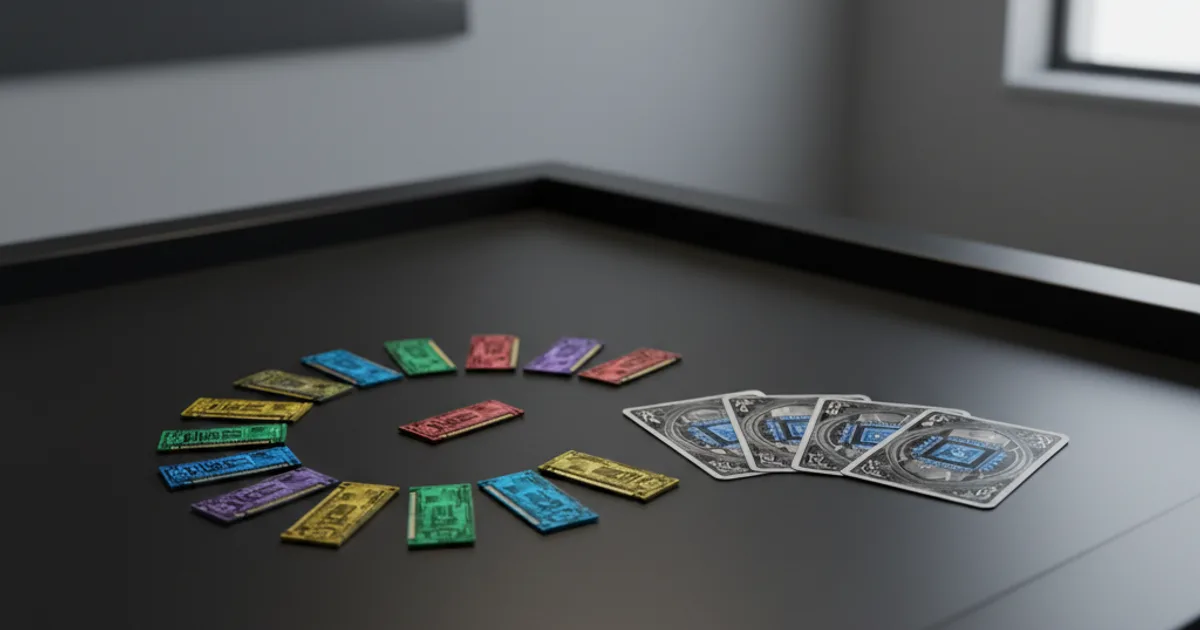
Type "Basic Ram" into the search on our own card catalogue and you will get nothing. Zero results out of 255.
That is not a bug, and it is not us being coy. It is the first thing worth understanding about the resource system in Neuroscape, because the deck you build out of that card is a quarter of your game and the card itself does not behave like a card at all.
So here is the whole economy, end to end. Every rules claim below comes from our rules page and glossary, which are our own reading of the publisher's Neuroscape Rulebook V10.2, updated 16 June 2026. Where the two disagree, the rulebook wins. Every card fact comes from our Genesis catalogue, all 255 cards of it, and where a claim rests on something our catalogue does not carry, we went and read the printed card. We will tell you each time we did.
The missing card, explained
Genesis is numbered GEN-1 to GEN-256. Our catalogue holds 255 of them, and the single gap in that run is GEN-255, Basic Ram.
It is held back deliberately. The platform types it as nothing at all, which is honest, because it is not a card you choose, draw, cast or evaluate. It is the unit your resource pile is made of, in the way a poker chip is not a card in your deck. Rather than give it a page that would tell you nothing, our rules page states the requirement instead.
Which is fine right up until a new player searches for it, finds a dead end, and reasonably concludes the database is broken. It is not. You are looking for a thing that is described rather than listed, and this article is where it is described.
Four piles, two decisions
A legal deck is four things, and our rules page is blunt about how few of them you actually choose:
- One mainframe. It starts the game face up in its own zone and you may only ever begin with one in play.
- A cyberdeck of 50 to 255 cards. Everything that is not RAM and is not a mainframe. That is a floor with a very high ceiling.
- A RAM deck of exactly 25 RAM cards. Exactly 25. A fixed count, not a maximum.
- A sideboard of up to 12 cards, plus up to one more mainframe. It may hold nothing.
Across the cyberdeck and sideboard together you may run at most four copies of a card, not four in each, unless a card says otherwise.
Read those again and notice how little of it is a judgement call. The mainframe is one slot. The RAM deck is a number with no range in it. All the deckbuilding lives in the cyberdeck and the sideboard, which is unusual, and which is exactly why the RAM deck is so easy to skip past on your way to the interesting part.
Skip it and you will misprice every card in the set.
25 is not a deck size. It is your lifetime budget
Here is the sentence that reorganises everything: RAM is installed from the RAM deck straight into your RAM bank, and it never passes through your hand at all.
You do not draw it. You do not shuffle it back. Our glossary defines the RAM deck as "a second deck of exactly 25 RAM cards. You install from it rather than drawing from it, and its cards never enter your hand."
So 25 is not the size of a deck in any sense you are used to. It is the total quantity of resource that will exist on your side of the table for the entire game, decided before anybody rolls for turn order. There is no top-deck that changes it, no ramp spell that raises it, no long game in which you eventually have more.
And you will almost never see all of it. During the draw/install step of your initialize phase you take two cards in total from your cyberdeck, your RAM deck, or one from each. One budget, not two. The player going first takes only one on their first turn.
Do the arithmetic and it is bleak in a useful way. Installing at the maximum rate of two per turn, and drawing absolutely nothing beyond your opening five, you finish installing your 25th RAM on turn thirteen. Going first or second, it lands on thirteen either way. Nobody plays like that, because a hand of five cards and no draws is not a game plan, so in practice the number of RAM you will ever have is somewhere well under 25 and every point of it was bought with a card you did not draw.
That is the trade the whole format runs on. Not mana versus spells. Cards versus cards.

Running, refreshing, committing
Three words that get used interchangeably by new players and mean three different things.
Running is payment. You pay a cost by rotating RAM 90° clockwise. The RAM stays in your bank. Our glossary is precise about this: running RAM is how you pay, and running a character is how it attacks or pays for an ability.
Refreshing is recovery. Every piece of running RAM stands back up during the refresh step of your initialize phase, ready to be spent again.
If that were all, RAM would behave like ordinary lands and this article would be over. It is not all.
Committing is the one that hurts. RAM spent on a character is not merely run. It moves out of the bank entirely and sits underneath that character for as long as it stays in play. It does not refresh, because it is no longer in your bank to refresh. When the character leaves, the RAM returns to its owner's bank running.
So your bank is not 25 minus what you have installed. It is 25 minus what you have installed, minus everything currently parked under a body.
Across the 235 Genesis cards that print a RAM cost, the mean cost is 2.67 and the median is 2. The 20 mainframes print no cost at all, because they begin the game in play. Characters average 2.78. Divide 25 by that and you get about nine: nine average characters is a board that has spent every resource you will ever own, with nothing left over for a program, a piece of gear or an ability, ever again.
The top of the curve makes it vivid. Jabberwocky (GEN-217) is a 9/9 for six with a completely blank text box, and it is also 24% of your lifetime bank, parked, indefinitely. Project Archangel (GEN-220) is a 10/10 for seven, and 28%. There are exactly two seven-cost cards in the set and 23 that cost five or more. They are not expensive. They are mortgages.
The automatic top-up, and the dice that follow
Now the rule that turns a budget into a threat.
If committed RAM leaves play, or an effect raises a character's cost, RAM is pulled from your bank automatically to cover the difference. Refreshed RAM first, then running. You do not get to decline. If you cannot cover it, the character stays in play underpaid, and that is what the system check at the top of your turn is looking for.
Fail that check and your mainframe becomes unstable, and the board starts rolling dice. A d20 for each character and each program you control, not only the one that is short. On 0 to 10 that card is destroyed. On 11 to 20 it survives. You roll lowest cost first and work upwards, and you must say which card a roll is for before you make it.
Read that again with the word "programs" in mind. A single underpaid character puts your whole board on a coin flip, including cards that had nothing to do with the shortfall.
Genesis prints a card that does this to you on purpose. Artificial Inflation (GEN-86) increases the RAM cost of non-Corpo cards by 1, and the card takes the trouble to spell out the part that matters: "This includes committed character costs." Every non-Corpo body on the table suddenly owes one more. Anyone whose bank is empty because they spent it all on bodies now has an unpaid board, and next turn they roll for all of it.
Five cards in Genesis can destroy RAM on the other side of the table. EMP Grenade (GEN-119) does it for two, at swift speed, and Dust to Dust (GEN-113) takes a RAM and a character together. The other three want a connecting attack first: Coyote Raiders (GEN-103), Badlands Marauder (GEN-104), and the gear Snatcher (GEN-60), which destroys one of theirs and installs one of yours in the same breath.
In a game where the pile refills, that is an annoyance. Here it is amputation. Nothing gives it back.
Nothing gives it back
We checked all 255. No card text in our catalogue refers to the RAM deck at all. Nothing searches it, nothing shuffles into it, nothing returns a destroyed RAM to it. Four of the 255 carry no rules text on our pages, and we opened those four by hand rather than let a parser tell us they were empty. The one caveat is the data hole described at the end of this piece: our pages carry the effect of an activated ability and not its cost, so read that sweep as covering what cards do, not what they charge.
The nearest thing to recovery is Tax Evasion (GEN-85), and it is worth being precise about what it does, because it is easy to misread as a safety net. When a character you control is destroyed by an opponent, its committed RAM returns to its owner's bank refreshed rather than running. That is a tempo refund on RAM you still own. It has nothing to say about RAM that was destroyed, which is gone.
So the honest way to think about your 25 is as a health total that only goes down.
What "acceleration" actually buys
Twenty-five cards in Genesis mention installing RAM. Almost none of them do what the word acceleration suggests.
The clearest case is a seven-card cycle of one-cost commons: Admin (GEN-2), Scrapper (GEN-33), Executive (GEN-66), Scavenger (GEN-97), Psychic (GEN-128), Roadie (GEN-171) and Nanobot Harvester (GEN-201). Each is a 1/1 for one RAM, and each reads, on our card page, "Install 1 RAM running."
Which looks like the best accelerant in the game, and is not, and this is the one place we have to tell you our own pages will mislead you.
Our catalogue does not carry the cost of an activated ability. We read all seven printed cards to check, and every one of them turns out to be an activated ability with a name and a price: UPGRADE on Admin, SCRAP HEAP on Scrapper, ACQUISITION, RECLAIM, ABUNDANCE, LOAD IN, POLLINATE. The cost, printed identically on all seven, is 2 RAM plus running the character itself.
So the real transaction is: pay one RAM to deploy the body, then later pay two more and run it, to install one RAM running. Running RAM is already spent this turn, so nothing about that sequence gives you a resource today. It costs you two.
What it does buy is a permanent point of bank without touching your two-card budget. That is genuinely valuable, because the budget is the scarce thing and RAM installed this way is RAM you did not spend a draw on. But it is a card you did not draw all the same, plus a body, plus two RAM, plus the run. Call it what it is: an exchange rate, not a windfall.
A handful of cards do better. Market Manipulation (GEN-83) installs X RAM running where X is your Corpo synergy, which scales with a board you were building anyway. The Empress (GEN-148) draws one and installs one at swift speed, doing both halves of the budget in a single card. Venture Capitalist (GEN-74) doubles a counter every netcheck and converts the pile into installs, which is the only card in the set that looks like it might genuinely break the economy if left alone.
And Hyperclock (GEN-24) is the format's honest villain. One RAM, plus an additional cost of 3 mainframe and 3 bioframe health, installs three RAM refreshed, and then destroys three RAM you control at end of turn. Refreshed, not running, so you get to use them immediately. It is a genuine burst, paid for in blood, and the three it destroys are three you never get back out of a pile of 25. Six of your forty starting health and 12% of your lifetime economy, for one enormous turn.

The mainframe is the only real engine
Which brings us to the one card that beats the budget outright, and you never draw it either.
A-Z Luxureon (GEN-239) is a Corpo common mainframe with two tiers. We read the printed card, because our pages do not show mainframe thresholds. At 2 cards in play and 2 Corpo synergy: "Your RAM comes into play refreshed." At 4 and 4, it adds: "On your SYSTEM CHECK, install 1 RAM refreshed."
Take those one at a time. The first upgrades every install you make, including all seven of those cycle characters, from running to refreshed, which converts the exchange rate above from bad to good. The second installs a RAM every single turn, refreshed, at the system check, before your draw/install step, entirely outside the two-card budget and at no cost whatsoever.
That second tier is the only unconditional free resource in the set. It is on a common. It starts in play, cannot be discarded, cannot be drawn dead, and turns up in every game you play. Omnis Blood Diamond (GEN-240) and Spotlight (GEN-251) install too, at prices of their own.
If you take one deckbuilding lesson from all of this, it is that the resource question in Neuroscape is answered by your mainframe choice, before the first card of your cyberdeck is picked.
An honest word about our own tools
We host ten public Neuroscape decks as of 8 September 2026, all published on 2 September. That is far too small a corpus to say anything about a metagame, and our site says so itself: card pages that would ordinarily print a play rate currently read "too few decks to publish a rate." We are not going to invent one here. There are no tournament results published anywhere we hold either, so nothing in this article is a claim about what wins. It is a claim about what the rules make possible.
Two structural things in those ten are worth reporting, though, because they are facts about the lists rather than about the meta.
All ten sit at exactly 50 cards in the cyberdeck. Not one uses a single card of the 205-card headroom the rules allow.
And all ten show RAM deck · 0 / 25 in our deck builder, while also showing a green tick that says Legal.
That is our gap, not theirs. Because Basic Ram is held out of the catalogue, there is no card record for the builder to put in that pile, so it counts zero and passes the deck anyway. Every one of those lists is a real 50-card cyberdeck with a real mainframe. The 25 RAM sit beside it in the physical game, the same 25 in every deck ever built, which is precisely why the card is not in the database and precisely why the counter reads zero. We would rather tell you that than let you find it and wonder.
Two things our pages do not settle
In the interest of not smoothing over the seams:
Gear and RAM cost. Our rules page says, in its section on gear ports, that "gear does not cost RAM," while its own card-type entry says that no RAM is committed to it. All 30 Gear cards in Genesis print a RAM cost, from 1 to 5, and our glossary defines RAM cost as what a card costs to play. The reading that fits everything is that gear costs RAM to play and commits none, which makes it meaningfully cheaper than a character of the same number. But our page can be read the other way, so if it matters at a table, the rulebook settles it and we would rather point you there than pick for you.
Activated ability costs. As above, our card pages carry the effect and not the price. That is a known hole in our data and the reason we read printed cards for every ability quoted in this article. Until it is filled, a card of ours that seems too good for its cost is worth checking against the physical card.
The short version
- Your RAM deck is exactly 25 and never enters your hand. It is a lifetime budget, not a deck.
- Installing costs you draws. Two cards per turn, total, from either pile.
- Committed RAM leaves your bank while the character lives. About nine average characters spends everything you will ever have.
- Underpay a character and every character and program you control rolls a d20 to survive.
- Destroyed RAM is gone. Nothing in Genesis returns it, and nothing in Genesis refers to the RAM deck at all.
- Acceleration mostly buys you bank at the price of tempo. The mainframe is the only card that gives resources away free.
The best thing about the 25-card RAM deck is that you build it once, correctly, forever, and then never think about it again. The worst thing is that everyone assumes this means it does not matter.